

From Passive Monitoring to Energy Intelligence: Controlling the Invisible Drain in Commercial Buildings
The Inadequacy of the Monthly Utility Bill in Industrial Energy Management
In the modern commercial landscape, energy has long been categorized as an unavoidable operational expense (OpEx)—a “black box” cost that facilities managers and building owners simply accept as a prerequisite for doing business. This perception stems from a fundamental lack of visibility, where energy remains an invisible drain on corporate resources. Traditionally, the primary tool for managing this expense has been the monthly utility bill. However, treating a utility bill as a strategic management tool is a significant fallacy.
The monthly bill is a “lagging indicator.” It provides a historical summary of what was spent but offers no contextual explanation as to how, where, or why that energy was consumed. It offers history, not insight. To achieve true operational efficiency, building leaders must transition from viewing energy as a fixed cost to treating it as a manageable asset. This requires a strategic shift toward “Energy Intelligence”—a technical framework that moves beyond passive monitoring to active, data-driven control. By moving from monthly estimates to real-time precision, organizations can unlock immediate savings, mitigate financial risk, and foster a genuine culture of sustainability that resonates from the boiler room to the boardroom.
The Architecture of Visibility: Moving Beyond the Main Meter
Meaningful efficiency cannot exist without high-fidelity, granular data. If you cannot see how energy is being consumed with precision, you cannot control the waste associated with it. Most commercial buildings rely on a single main meter that aggregates the consumption of the entire facility. This total building data often masks significant inefficiencies by smoothing out spikes and burying the heavy consumption of specific failing assets within a generalized average.
The first stage of a mature energy strategy is Granular Data Acquisition. This requires hardware capable of “Class 0.2” metering accuracy, monitoring up to eight three-phase channels per unit to ensure data integrity. Furthermore, true intelligence requires a holistic view; the energy management system should monitor not just electricity, but gas and water in one centralized location. By moving “beyond the main meter,” facility managers can unmask specific “energy abusers” that typically hide in generalized data:
- HVAC Systems: Identifying units that run unnecessarily during off-hours or have mechanical issues causing excessive draw. Detecting a failing compressor at the circuit level allows for scheduled maintenance rather than an emergency capital expenditure (CapEx) for total replacement.
- Lighting Arrays: Uncovering zones where automated sensors have failed or where manual overrides remain active indefinitely, leading to thousands of dollars in unnecessary annual spend.
- Heavy Machinery: Detecting equipment operating outside optimal power quality parameters. This serves as a vital risk mitigation tool, preventing asset depreciation and premature motor failure.
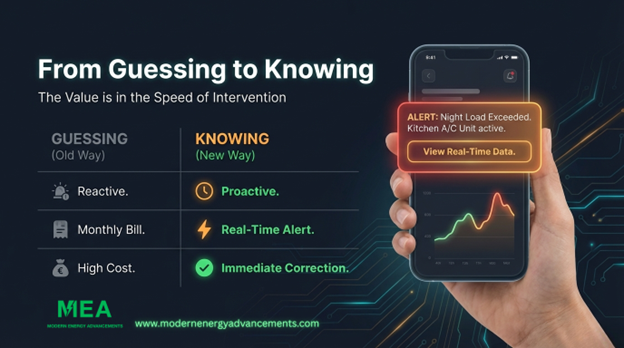
Unmasking these abusers transforms the management process from guessing to knowing. However, while visibility is the foundation, the ultimate value of this data is realized through the speed of intervention.
Real-Time Intervention and Deep Analytics: The “Virtual Energy Manager”
Data without analysis is merely noise. To bridge the gap between visibility and control, organizations must implement real-time monitoring and deep analytics—stages two and three of the energy intelligence methodology. This approach replaces “Reactive Management”—the process of finding a consumption spike thirty days too late—with a “Proactive Defense.”
By utilizing genuine real-time performance data, facilities can stop waste the moment it happens. The integration of SMS and email alerts provides an immediate safeguard against operational errors and ‘supply penalties.’ For example, across large-scale retail deployments, these automated alerts have been used to identify equipment left running unnecessarily during closing hours, frequently resulting in night-hour consumption reductions of over 80% and significant annual cost recovery.
Complementing these alerts is the “Deep Analytics” layer, which functions as a 24/7 Virtual Energy Manager. A key strategic advantage of the modern solution is that it is entirely web-based, requiring no software installation and offering remote access from any browser. This allows stakeholders to:
- Itemize Consumption: View a detailed breakdown of usage by building, department, circuit, or specific machine, allowing for targeted efficiency audits.
- Monitor Power Quality: Track the health of the power supply to avoid maintenance issues. By identifying irregular power trends, managers can implement preventative maintenance before a critical asset fails.
- Automate Reporting: Receive daily email reports that expose weaknesses and show improvements, ensuring energy performance remains a top-of-mind metric for leadership.
The Human Element: Driving Behavioral Change through Transparency
Technology is only half the battle in the pursuit of an intelligent building. The strategic importance of human behavior cannot be overstated; even the most efficient HVAC system can be undermined by poor operational habits. This is where Stage 4—Public Displays—becomes a catalyst for organizational change.
By making energy conservation “visible and beautiful” through high-quality public data displays, organizations remove the “anonymity of waste.” The use of “Energy League Tables” introduces gamification into the facility, promoting healthy competition between staff members, departments, or different sites within a multi-site estate. When employees see the real-time impact of their actions on a leaderboard, behavioral change occurs naturally, often achieving savings that hardware alone cannot reach.
The “Value of Awareness” is best demonstrated by the StyleMark (makers of Polaroid eyewear) case study. By implementing a trial on a test panel to make consumption transparent, the organization achieved an immediate $10,000 saving in the initial trial and a 50% energy reduction in that segment. This behavioral shift contributed to a 20% facility-wide saving in the first year alone. When energy use is made transparent, the human element naturally seeks optimization, providing the momentum to justify more complex capital investments.
Validating the “Green” ROI and Renewable Integration
Many sustainability initiatives fail at the boardroom level because they lack verifiable data to support financial claims. Stakeholders are often hesitant to invest in renewable technologies or major retrofits when the return on investment (ROI) is calculated using estimates.
The fifth stage focuses on Renewable Energy and the verification of green credentials. Real-time displays allow owners to showcase the benefits of investments—such as solar or wind—to visitors and staff. This high-fidelity monitoring provides the “financial confidence” required for further investment. As Robert Johnson, CEO of Coquina Office Park USA, noted: the solution “saved us 38% of our costs which is almost a 1-year payback.”
The financial impact of this total solution is globally proven, with organizations consistently seeing savings of up to 43% and an ROI of less than one year. A major project with 7-Eleven, involving over 120 store locations, exemplifies this scalability. By utilizing monitoring hardware to identify low-cost and no-cost solutions, the project achieved an 11.52% average saving—totaling 2,700,000 kWh and 864 tonnes of CO2 saved. Whether managing a single office or a massive retail roll-out, precision data is the only path to environmental and financial success.
From “Smart” to “Intelligent”
The transition from a “smart” building to an “intelligent” one is defined by the move from passive data collection to active, informed decision-making. By transforming energy from an invisible, unmanaged drain into a visible and manageable asset, building owners reclaim control over their operational destiny.
The path to true decarbonization and operational excellence is not paved with trial and error or monthly estimates. It is built on a foundation of granular, real-time data and a culture of transparency. As we look toward the future of the industry, data-backed decisions remain the only viable path to achieving both aggressive sustainability goals and a healthier bottom line. Making the invisible visible today is the first step toward a more efficient and profitable tomorrow.

Matt Trudeau, COO of Modern Energy Advancements, brings twenty years of strategic clean-tech experience to the ASHB community. Dedicated to corporate sustainability, Matt specializes in transforming energy into a manageable asset. He helps organizations reduce their carbon footprint and enhance efficiency through the implementation of granular, real-time energy intelligence solutions.


